Showing posts with label Amanda's Blog. Show all posts

Wednesday, November 27, 2019

Dangers of Weight Watchers’ new App for Children and Teens

Why hasn’t weight watchers failed yet when it only has a 6% success rate?  Just the opposite is happening— the company has launched a new app called Kurbo, which is geared towards children aged 8-17 that is “designed to help kids and teens reach a healthier weight”  You heard that right— children who are as young as 8 years old are in the target range for this app.  In our current society, which glorifies being thin and shames those who are fat, an app like this is the last thing we need.

The app claims that its goal is to promote health, but based on the testimonial page on the website, the main goal is definitely to lose weight; successful kids and teens are showcased on the page with a photo, their age, and a sentence listing how many pounds they’ve lost or how many points their BMI has decreased, both of which of problematic.  


BMI charts are known to be inaccurate, especially for taller or more muscular individuals, and those who are fat are not necessarily unhealthy.  In fact,  between one-third and three-quarters of fat people were metabolically healthy in terms of blood pressure, insulin resistance, and cholesterol levels.  In a study between unhealthy lean people and healthy obese people, the healthy obese group were less likely to be at risk for diabetes, coronary heart disease, strokes and mortality than the unhealthy lean people; “healthy” and “unhealthy” was determined by blood pressure, blood glucose, and blood lipids.  

But the Weight Watchers company has seemed to realize that weight loss or the act of “watching” weight isn’t the healthiest, recently deciding to shorten their name from Weight Watchers to just WW.  Maybe this can be seen as a step in the right direction, but there are still several issues with their Kurbo app and their diet cycle methodology.  

The app uses a system similar to a traffic light, gauging foods as either being in a red, yellow, or green group.  The app encourages users to track food intake and compensate for calories taken in with exercise, which places a huge burden on the child or teen using the app when, in reality, they may not have any control over the food is purchased in their house.  Many have pointed out that this type of categorization of “good” and “bad” foods and behaviors could lead to the development of unhealthy habits and potentially, even eating disorders, especially for children and teens who are still very impressionable. 

Additionally, this app could introduce kids and teens to the diet cycle of yo-yo dieting, which is harmful in the long turn and can cause individuals to fall into an unhealthy relationship with food.  This diet cycle involves restricting oneself of food, indulging in food, and then ultimately punishing oneself for doing so.  This process is one of the reasons that Weight Watchers and other dieting programs stay so successful and why two-thirds of dieters regain more weight that they lost in the first place. 

So what are parents supposed to do? First and foremost, stay away from the Kurbo app and the focus on dieting in general since it can be detrimental to health in the long term.  Second, parents should promote healthy habits in a way that doesn’t focus solely on weight because it is time to move away from the stereotype that fat individuals are automatically unhealthy. 

Monday, November 4, 2019

Three decades after ADA Law Passed: Still a Lack of Wheelchair Accessibility on College Campuses

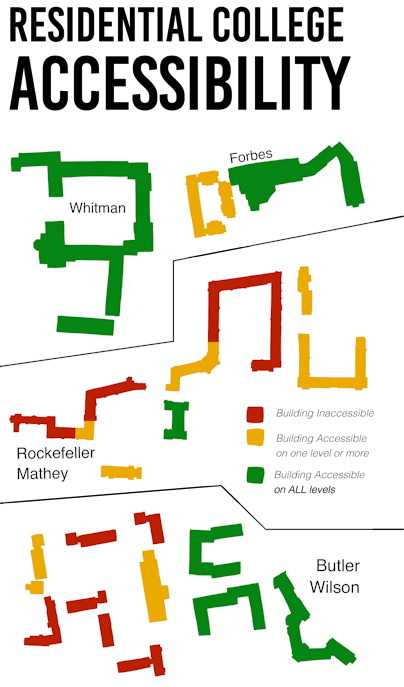
How many of the buildings are wheelchair-accessible on Allegheny’s campus?  Maybe half of them, but that’s only if the residence halls aren’t included.  But we definitely aren’t the only campus with a lack of accessibility.  Across the country, more than 25 colleges, such as Princeton, Yale, and MIT, have all been involved in lawsuits or various investigations due to their lack of accessibility.  It’s been 3 decades since the Americans with Disabilities Act (ADA) was passed, which requires new constructions to meet certain accessibility standards, but the language is vague for pre-existing buildings, stating that “reasonable accommodations” must be made.  

Well what exactly is “reasonable” and who gets to make that decision?  For me, reasonable would be if students in wheelchairs could attend classes and get to and from their dorms (and I’d argue their friends dorms as well) without the physical barriers of a lack of elevators or ramps to enter buildings. 

Varying wheelchair accessibility levels of
buildings on Princeton's campus
A lot of progress has been made in the last 25 years, but at several schools, barriers are still in place that prevent students in wheelchairs from attending that institution at all.  In fact, the Christopher and Dana Reeve Foundation recommends that students visit schools prior to attending in order to determine if schools meet their needs.  Then once at a school that’s “accommodating,” students in wheelchairs still face the burden of working with the disability services department to secure any accommodations that they may need, which doesn’t always go as smoothly as we’d hope. 

At the University of Buffalo, students are speaking out about their experiences of a lack of access.  Graduate student, Emily Tout, says that even her child’s size wheelchair doesn’t fit in many of the bathrooms.  In a building where she had class frequently, Tout had to ask a friend to carry her from the hallway to the stall, to the sink, and then back to her wheelchair whenever she wanted to use the bathroom.  Another student, Connor Gow, had to try to balance his laptop on his legs during class since there were no accessible tables. A third student, Zachary Dickman, missed class because his classroom lacked an access button, and no one knew that he was trying to get in.  

The University of Buffalo recognizes that it isn’t 100% compliant with ADA guidelines, mostly due to the age of the buildings, but I’m not so sure that this is the only issue at play.  Even at schools with more accessibility accommodations in place, students face issues of gaining access to resources such as elevators.  At Columbia, Eun Oh went through all the necessary steps to gain elevator access to the elevator and skybridge that she needed to get to her class, but realized the day of class that she nor a disability services employee had access.  By the time she was let in, she missed her entire class— she ended up dropping it.  

Although the physical structure and age of several academic buildings poses a huge problem to accessibility, experiences like Oh’s where access could be granted, but isn’t, are not uncommon.  When colleges have the ability to give access and don’t— whether it’s elevator access or neglect to shovel snow off of ramps to get into buildings— it sends the message that we don’t care about whether or not students in wheelchairs have access.  

This needs to change.  I know that renovations to old buildings to make them accessible aren’t always financially feasible but it is something that colleges should be actively working towards.  Additionally, steps to ensure that students are given proper access to already-existing accommodations should be taken more seriously because it is definitely not "unreasonable" for students in wheelchairs to be able to access their classes. 

Disability. You're Helping Too Much

Lamar Todd Professor Shaw WGSS 275 December 10, 2019 Blog #2: Disability. You’re Helping Too Much. On the CDC (center for dis...